4:2-Fluortelomeralkohol
| Strukturformel | |||||||||||||||||||
|---|---|---|---|---|---|---|---|---|---|---|---|---|---|---|---|---|---|---|---|
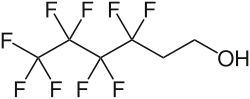
| |||||||||||||||||||
| Allgemeines | |||||||||||||||||||
| Name | 4:2-Fluortelomeralkohol | ||||||||||||||||||
| Andere Namen |
| ||||||||||||||||||
| Summenformel | C6H5F9O | ||||||||||||||||||
| Kurzbeschreibung |
farblose Flüssigkeit[1] | ||||||||||||||||||
| Externe Identifikatoren/Datenbanken | |||||||||||||||||||
| |||||||||||||||||||
| Eigenschaften | |||||||||||||||||||
| Molare Masse | 264,09 g·mol−1 | ||||||||||||||||||
| Aggregatzustand |
flüssig[1] | ||||||||||||||||||
| Dichte |
1,59 g·cm−3[1] | ||||||||||||||||||
| Siedepunkt | |||||||||||||||||||
| Löslichkeit |
schwer löslich in Wasser (0,97 g·l−1 bei 20 °C)[2] | ||||||||||||||||||
| Brechungsindex |
1,31 (20 °C)[1] | ||||||||||||||||||
| Sicherheitshinweise | |||||||||||||||||||
| |||||||||||||||||||
| Wenn nicht anders vermerkt, gelten die angegebenen Daten bei Standardbedingungen (0 °C, 1000 hPa). Brechungsindex: Na-D-Linie, 20 °C | |||||||||||||||||||
4:2-Fluortelomeralkohol ist eine chemische Verbindung aus der Gruppe der Fluortelomeralkohole.
Vorkommen
4:2-Fluortelomeralkohol wurde in Norwegen in Sedimenten nachgewiesen.[3] Auch in Handelsprodukten wurde es nachgewiesen.[4]
Eigenschaften
4:2-Fluortelomeralkohol ist eine farblose, klare Flüssigkeit.[1] In der Atmosphäre reagiert es mit freien Chloratomen und OH-Radikalen zu verwandten Verbindungen wie Perfluorcarbonsäuren.[5][6][7]
Sicherheitshinweise
Die Verbindung ist die giftigste der homologen Reihe.[8]
Einzelnachweise
- ↑ a b c d e f g h Eintrag zu 1H,1H,2H,2H-Nonafluor-1-hexanol, >97.0% bei TCI Europe, abgerufen am 2. Februar 2024.
- ↑ Zhenlan Xu: Fluorotelomer alcohols, perfluoroalkyl acids and semifluorinated alkanes in the house dust, air and sediment. 2014.
- ↑ Martin Schlabach, Peter Haglund, Malcolm Reid, Pawel Rostkowski, Cathrin Veenaas, Kine Bæk, Bert van Bavel: Suspect screening in Nordic countries. Nordic Council of Ministers, 2017, ISBN 978-92-893-5200-0, S. 28 (eingeschränkte Vorschau in der Google-Buchsuche).
- ↑ Matthias Kotthoff, Josef Müller, Heinrich Jürling, Martin Schlummer, Dominik Fiedler: Perfluoroalkyl and polyfluoroalkyl substances in consumer products. In: Environmental Science and Pollution Research. Band 22, Nr. 19, 2015, S. 14546–14559, doi:10.1007/s11356-015-4202-7, PMID 25854201.
- ↑ M. P. Sulbaek Andersen, O. J. Nielsen, M. D. Hurley, J. C. Ball, T. J. Wallington, D. A. Ellis, J. W. Martin, S. A. Mabury: Atmospheric Chemistry of 4:2 Fluorotelomer Alcohol (n-C4F9CH2CH2OH): Products and Mechanism of Cl Atom Initiated Oxidation in the Presence of NOx. In: The Journal of Physical Chemistry A. Band 109, Nr. 9, 2005, S. 1849–1856, doi:10.1021/jp045672g.
- ↑ M. D. Hurley, J. C. Ball, T. J. Wallington, M. P. Sulbaek Andersen, D. A. Ellis, J. W. Martin, S. A. Mabury: Atmospheric Chemistry of 4:2 Fluorotelomer Alcohol (CF3(CF2)3CH2CH2OH): Products and Mechanism of Cl Atom Initiated Oxidation. In: The Journal of Physical Chemistry A. Band 108, Nr. 26, 2004, S. 5635–5642, doi:10.1021/jp0493576.
- ↑ Mohammednoor Altarawneh: A closer look into the contribution of atmospheric gas-phase pathways in the formation of perfluorocarboxylic acids. In: Atmospheric Pollution Research. Band 12, Nr. 12, 2021, S. 101255, doi:10.1016/j.apr.2021.101255.
- ↑ Reviews of Environmental Contamination and Toxicology Volume 256. Springer International Publishing, ISBN 978-3-03088140-5, S. 81 (eingeschränkte Vorschau in der Google-Buchsuche).